Tag: High return investments

  • Investment on Stocks and Shares -Pros and Cons

    Investment on Stocks and Shares -Pros and Cons

    Today investment is so popular as everyone wants to increase their assets.But finding the right choice of investment is quite difficult . Short term investment or long term , and where to invest all this buzz every investors head. Investment on Stocks and Shares is always the popular choice.

    Investment on Stocks and Shares 

    Let us take a look on the Investment on stocks and shares to understand which is the right investment choice .

    stocks-and-shares

    But all have a confusion where they have to invest – Is it on stock or on shares. In order to answer this you should the pros and cons of stocks and shares.

    Read Also : Short term Investment Plans – Pros & Cons

    What is Stock?

    You might have heard the term stock not only in financial sector but in many fields where purchasing is involved. In financial sector, Stock is nothing but a general term which is used to describe the ownership in a company or corporation. It is issued by means of certificates which are called ‘Stock Certificates’. To put it in simple words, stock is a collection of shares.

    stock

    Stocks can be either Preferred or Common. If someone is holding a common stock in a company, they can attend the board meetings and participate in the voting for decisions taken on various issues. On the other hand, if someone is holding a preferred stock, they can’t vote. But Preferred stock holders are eligible for receiving dividends from the company.

    What is Share?

     We are hearing daily about the share market in the news section in TV channels. Share is nothing but the smallest unit of a stock and it is specific to the company. For eg. “I bought N shares of C Company”. Here N indicates the number of shares bought and C is the name of the company. Unlike stock, share can be measured in numbers. If a person has bought more number of shares of a particular company, then he/she becomes the shareholder of the company. Generally companies will release only certain portion of their shares to public.

    share

    Here you have seen stocks vs shares . Now to know more in detail you should know the pros and cons involved in both investment to take a wise decision. Investment decisions is based on the risk involved and the preference of risk. So you have to decide your investment choice by evaluating the pros and cons.

    By just knowing what a stock is and what a share is you cannot take any major decision on Investment on Stocks and Shares. So know further to increase your knowledge on investments.

    A .1 ) Stock – Pros and Cons

    Pros:
    • Dividends: If someone buys a preferred stock, they will get dividends from the company which can be used for reinvesting again.
    • Passive Income: Any income from the stocks is passive as you don’t have to put any effort for getting money.

    stock-pros-and-cons

    Cons:
    • No Minimum Guarantee : As the stock market is fluctuating, there is no minimum guarantee for profit. You cannot predict the interest amount as compared in other financial sectors like banks.

    So here you are understanding investments and stocks . This will give you key idea on stock but to take a final decision of investment you should know the pros and cons involved in shares as well.

    A .2)Share – Pros and Cons


    Pros
    :
    • Passive Income: Share trading is a good source of passive income as you are getting money without putting any effort.
    • Qualification: You don’t need any great qualification for investing in shares but a basic knowledge about shares are enough to start with.
    • Travel: You don’t have to travel or do any physical work for investing in shares. It is very flexible and you can work at your own timings by relaxing and  sitting at home.
    • Less Investment: As shares are available in various ranges of prices, you can buy shares with less value and you don’t have to spend more money which is especially helpful for beginners.

    share-pros-and-cons

    Cons:
    • Share Buying : Buying wrong shares may result in heavy loss which will affect you physically as well as mentally.
    • Quarterly Results: When a company announces its quarterly results, you can see a drastic change in the price of the share. If the results are bad, then your share price will go down.

    So here you are having 50 % knowledge about Investment on Stocks and Shares. Moving to know further on stocks and share will help you to decide better on investment .

    Read Also : Improve Credit Score For Getting Loan Approval – CIBIL Score Detailed

    Top 5 Factors to Consider When Selecting a Stock

    • Always choose stocks that offers dividends as it is more beneficial for your future investment.
    • Find the market cap for the stock you are buying. Mid cap stocks are usually better than other stocks as they provide best return on investment stocks .
    • Find out whether the price you are paying for the stock is really worth. Sometimes we may spend more money for the items than their actual price. 
    • Find the enterprise value of the company from which you are going to buy the stock. It will help to find the true value of the company.
    • If you want to become a long term investor for a company stock, you should gather all information about the company like products/services offered, top level management, future projects, profit/loss balance sheet etc.

    stocks-vs-shares

    Factors to Consider When Selecting a share

    • Before buying the share of any company, add the company to your watch list for a week or so and observe its rates daily. There are many free portfolio trackers available online. You can subscribe for one and start analyzing. Also gather information about the company’s performance and its growth.
    • Divide you share investment equally into shares that grow quickly and constant growth shares. Oil company shares are quick growth shares as the oil prices are changing often. Shares of Banks provide a constant growth as there is no sudden change in their policies.

    You should analyse the risk to take an investment choice and it differs from one person to another .So you should know this before buying stocks and shares.

    Investment on Stocks and Shares should be analysed by knowing the risk involved in it . Some of you may be risk lovers and some o you will be risk averse. So which gives you the lesser standard deviation you can go for that when you think about increasing your asset.

    Risks in Stocks

    • Losing money – Loss of money is the biggest risk in stock trading as there is no minimum return guaranteed as the stock market is fluctuating.
    • Credit Rating – If the credit rating of a company goes low, it will affect the price of the stock because the company is getting its financing or loans based on it. A low credit rating means the company is not able to pay its debts in time which indicates a poor performance of the company.
    • Media – If a company is making a news to the media often even if it is a rumor, it will affect the price of the stock badly.

    Read Also : Gold purity and hallmark -Buyer’s Guide to choose the Pure Gold Jewellery

    Risk in S­­hares

    • Fluctuation: The biggest risk in share is instability as the price of the share is not constant and changes daily. On the positive side, you will get profit in short time if the price of your share increases. But if falls drastically, you will suffer a heavy loss if you hold more number of shares of that particular company.
    • Health factors: You may have to monitor the price of a share daily if you are investing huge amount of money. You cannot sell the shares if the prices has dropped and have to wait till it goes high. This may affect your sleep in the night as you will be thinking what will happen tomorrow.
    • Choosing Right shares: If you are beginner in share trading and doing it without the help of any financial advisor, it will be difficult for you to choose the right shares as you don’t have much knowledge.
    • External factors: There are many external factors which decide the price of a share without your involvement like change of government, change of directors of the company etc. Suddenly the company may go bankrupt and you will get zero money as return, in such scenarios.

    Conclusion

    Investing in shares and stocks are not free from risks. But if they are analyzed and invested correctly, you can yield high returns.So you can now decide about Investment on Stocks and Shares according to your choice.


  • Short term Investment Plans – Pros & Cons

    Short term Investment Plans – Pros & Cons

    The frenzy to accumulate as much as possible starts from ants and ends with humans. We live a life building ground for our next step. Finance planning has taken major portion of your brain’s activity, not to mention the stress lines on your forehead and premature grey along your hairline. There are two types of Investment -Short term and long term. Standing at the fork of these roads, we ponder over the lengthy mundane policy guidelines looking for a helpline, a simple sentence which conveys a simpler idea for smart and safe investment.To do a smart investment here we discuss on the Pros and cons of Short term Investment Plans.

    Smart financing is trending, and lack of patience and trust drives people to save somewhere safe and solid. Savings are done by investing your cash in some form that would yield returns/additional benefits- monetary or otherwise. There are different forms of investments, but the ones that all of us are clearly interested and working towards is how to reap what you sow in very less time. It means everyone is interested in short term investment plans.

    What is Short term investment Plans?

    In a not so professional-banker-style, it is to simply put away your resources or assets, which we will very cleverly refer to as capital ,to good use (by not spending it), for a span of few years (typically 1-3 years or less, in fact, it starts from 3 months onwards). It is not an investment until you get back more than what you have put in. So, that sums up our definition for a short term investment. Preserving your assets to ensure its safety and gain additional benefits on return.

    Still if it is not clear here it is in most simple words. Here is a more polished short investment definition .

    short-term-investment-plans

    Short Term Investments as the name itself will define it that it is short term ie) mostly investments made for short period of time. It is part of certain account of the present assets of some company’s current balance sheet usually.Short term investment plans are made for avoiding risk in the capital and it is mostly aimed to get converted to cash within an year.

    • It meets 2 requirements where first and foremost thing the asset which we have kept as short term investment should be easily convertible to cash .

    Example:  Stock price of a company will be attracted by investors to have a share of it.

    • Second requirement is that asset should be easily sold or convert to cash within a period of 3 to 12 months.

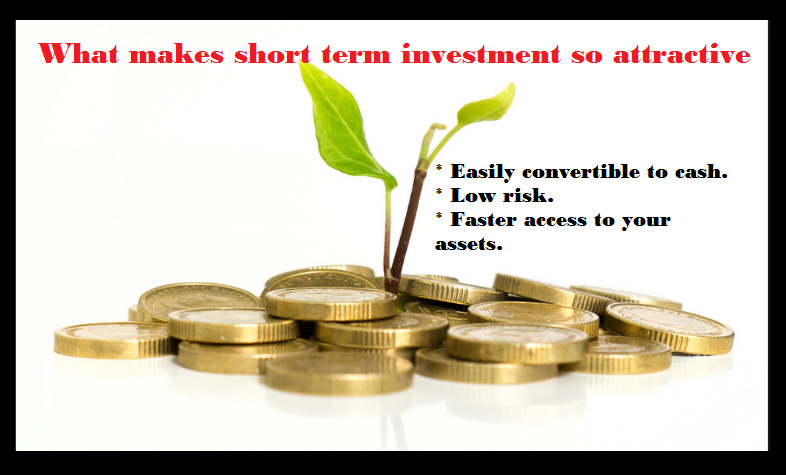
    What makes short term investment plans so attractive?

    Primarily, I would say, Need. The necessity to use the money in near future drives this kind of investment. Why is it so desirable?

    • The benefits of short term investment plans are that, firstly, you can break open your piggy bank sooner than later. The tenure for which the investment is made is short, ensuring low risk and faster access to your assets.benefits-of-short-term-investment
    • Secondly, the possibility of losing your investment is low. Short term investments generally are low risk investments given the time period and security (most of the available schemes). The idea behind investments of these kinds are to retain your assets more than multiply.­­

    Top Short Term Investment Plans

    So given that there are lots of investment schemes available, how do we choose the best? And what are the available choices. Here is the list of best short term investments with their pros and cons involved in each of them.

    Fixed Deposit

    If you have a problem with withholding cash and you want to get away from it without getting rid of it, fixed deposit is one such good short term investment plans.

    • A guaranteed investment :

    No risk involved. The return of your investment is certain.

    • No temptation:

    Idea of fixed deposit is to keep funds from being used for a stipulated period. Most banks do not encourage premature withdrawal (usually charged with a fee). This ensures the safety of the investment from self’s squanders.

    fixed-deposits

    • Flexibility of schemes:

    Money can be invested from 1 month or for 5 years depending on the investor’s convenience.

    • Fixed rate of interest:

    Fixed deposit ensures your cash remains safe but what it does not offer is

    • Higher returns :

    The returns at the end of tenure may/may not be higher than that of a savings account but it is not significantly high.

    • Low risk:

    May not be as fruitful as perhaps an investment in stock market or gold.

    • Not much of a tax benefit.

    So fixed deposit is a guaranteed Short term Investment Plans .

    Short term debt funds

     These schemes are basically mutual funds similar to FD in terms of the interest. MIP (monthly income plan), liquid funds, stocks and shares all come under debt funds.

    The advantage of short term debt funds over FD is tax benefits. This means the returns at the end of your stipulated period is more than what you receive from an FD.

    Gold Investment

    A typical investment in India where purchasing gold is considered a status quo and an investment. The idea behind assets in form of Gold is because of its high value in times of need. Considered to have highest resale value and continuous increase in price, this is one of the most preferred form of investment.

    Read Also : Gold purity and hallmark -Buyer’s Guide to choose the Pure Gold Jewellery

    Having said that, ornamental gold is not as much an investment as one expects.

    gold-investment

    • Taxes and Taxes:

    On purchase, additional bracket in your bill comprises of VAT, wastage, sales tax, making charges, which amount to a significant sum in the total bill. This is not considered during an exchange/resell. That is, the value of your gold is minus the amount you spent on previously mentioned categories.

    • Good for only updating to latest designs:

    The value of resale gold is not entirely taken. There is a 6-7% decline in the rate of resale gold and cashing it instead of exchange further reduces its value to about 10%

    • Storage:

    Physical storage of gold is not possible due to fear of burglary. In case these are preserved in bank lockers, a stipulated amount goes into maintaining them.

    • Wastage & Impurity:

    Extensive design requires extensive impurity. Mixing of other metals with gold for tensile strength is not an uncommon knowledge but the impurity matters when it is tested for sale. The amount of gold wasted (gold dust) for making these intricate designs are unaccounted for yet paid for. So end up paying for Gold more than it is worth.

    • Tax reduction:

    Investment in gold does not waiver your taxes as compared to other investment schemes that influence/reduce your Taxes. Lesser ITR, I say!

    • Unpredictable:

    The demand in gold has taken a massive dip many a times in past few years. This can happen in the future too. Unless you are buying gold, such conditions may not be favorable if you are trying to sell them.

    But, as mentioned, in case of dire needs, Gold can always be sold, mortgaged or exchanged at any point of time, making it a suitable investment.

    Savings Account

    Yet another common form of investment is savings account. The idea is simple and safe, every drop makes an ocean; a very famous dialog in our household every time I splurge on something.

    • Readymade withdrawal (ATM) and deposit of cash.
    • Account book becomes an additional identity proof
    • Quick transfer of money to other account.
    • Internet transactions.
    • Benefits on reaching prescribed goals set by particular bank.

    But what you may not get on a savings account is listed as follows.

    • Low interest rates:

    The growth of your investment is almost negligible.

    Each bank has a limit on the amount of customer’s deposit. If your savings exceed their limit, their insurance may not cover the rest of the amount.

    • And yes, the most obvious reason being, you will want to spend them. Given the easy access, it won’t be a tough job to do either.
    • Some banks have minimum balance maintenance. If the deposit/investment falls below their threshold, penalties are charged against the account holder, usually a certain amount.

     Recurring Deposit

    If you want to make a monthly saving but with better interest rates, recurring deposit is one of the ideal schemes available.

    • Deposit amount starts from as low as 500 upward
    • Fixed monthly investments.
    • Flexible duration: from 7 days to years as desired.
    • It has fixed rate of interest which is slightly better than savings account.

    Recurring deposits means periodic deposits. What may pose as constraints in recurring deposit are:

    • Punctual deposition: Money has to be deposited to your recurring account on time without fail, defaulting can cause penalty
    • Premature withdrawals are possible but some banks charge a fee.
    • No tax benefit.
    • Once fixed on the deposit money, it cannot be changed.
    • Low interest rates.

    Monthly Income Schemes

    Again counted to be a secured form of investing your assets for a short (optional) period. Monthly incomes schemes are offered by banks as well as post offices. MIS in post office is preferred over banks because of the following advantages:

    • Interest rate is good compared to fixed, recurring or saving account. Typically it is 8.5%.
    • Maturity period is for 5 years. So your investment stays safe for the period of time, growing.
    • A pre-closure facility is available after a year of opening the account but before 3 years.
    • It provides a monthly interest that can be credited to your account.
    • This interest in turn can be used as a source for recurring deposit or used for daily purpose.
    • These deposits are exempt from wealth tax.
    • The MIS can be opened by a single individual or 2-3 people together or for a minor through a guardian.

    All this makes it ideal short term investment plans for many .

    Given the interest rates are higher compared to other kind of deposits we have discussed so far, these deposits also come with some common limitations like

    • No tax benefit
    • Deduction of 1% if the account is closed prematurely after 3 years.
    • Limit in investment- 4.5 lakhs per individual and 9 lakhs for joint account.
    • Non-Indian resident is not allowed this investment scheme.
    • Minors have a deposit limit of only 3 lakhs

    The MIS schemes offered by banks and private financiers have longer maturity periods and is more a question of security of your investment.

    Recurring Deposit

    PPF is another vital short term investment diligently followed by the working class people. The benefits reaped from PPF are as follows:

    • No eligibility for opening the account. Opening a Public Provident Fund is a simple process and there are pre-requisites to be met for the same.
    • The savings cannot be withdrawn and has specific time period for which it has to be maintained- ensures the investment remains unspent.recurring-deposit
    • Good rate of interest. An interest rate of 8.7% is applicable per annum on PPF.
    • Tax exemption. This is one of the major reasons why PPF is more popular investment option. The annual investment to PPF and the interest earned out of are all exempted from your income tax.
    • Any amount can be deposited to your account. There is no fixed amount.
    • A loan or pre mature withdrawal from your PPF is possible.
    • It is also exempted from debt, liability and wealth tax.
    • A sure form of investment, the amount deposited remains safe.
    • This account, like MIS, can be opened for minors too.

    If you look for tax exemption on investment then this is the best Short term Investment Plans for those who want tax exemption.

    Though the benefits reaped are high, PPF investments come with clauses like –

    • Money cannot be withdrawn from the account until 7th year of opening your PPF account.
    • Joint accounts are not possible.
    • NRI (Nonresident of India) cannot have a PPF account.
    • Maximum investment cannot exceed 1.5 lakhs.
    • Investments can be made only 12 times in a fiscal year, much like a recurring account.
    • Most companies (public and private sector) make mandatory providential fund savings, which is no different from PPF. They even have a VPF (voluntary providential fund) open for employees who wish to make additional contribution to their savings.

    These are not just some of the short term investment schemes available but also most preferred ones in India. The goal behind a short term investment is to save the capital rather than multiply it. More than looking at the cons of a scheme, the nature of the scheme that would suit one’s needs should be analyzed. Read through the policy and guidelines, analyze different schemes available and the benefits, opt the one that suits the best.

    Draw a financial roadmap

    Form an idea as to how to much to invest, and for how long to invest. Consider your immediate and future needs and decide on the term of investment and then pick your ideal Short term Investment Plans.

    financial-roadmap

    Read through current affairs: Be aware of the shift in market, in terms of value of gold, stocks and shares, their growth.

    Analyze Risk: How much to invest is the question.

    From the different schemes available, consider the amount of money you are ready to invest and the kind of investment you are ready make based on the risk involved and the returns.

    Cash at hand: Always make a plan B. No matter how low risk it is, having a backup is good as far as money is concerned. Invest your money in different schemes and ensure there is always some emergency funds at hand for unpredictable circumstances.

    Financial Advisor : They can do the ground work for you and help you make a smart investment. Their insights on not just investment, but taxation and tax efficiency helps make a better financial plan.

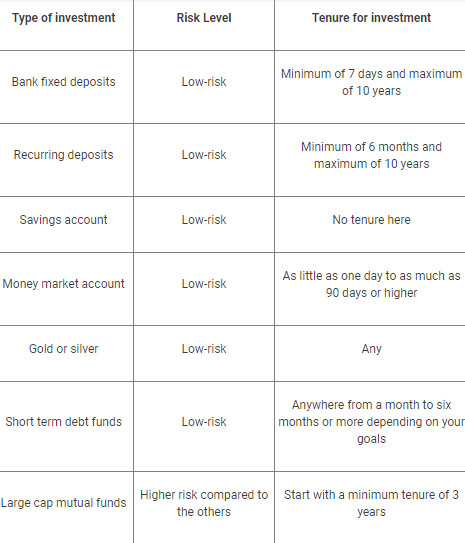
    Now let us understand the short term investment plans with their risk level , here is the investment risk level analysis chart –

    Chart explaining the risk level of different types of short term investments with tenure of investment
    Investment type and risk level chart

    Having read the whole article, do not make a decision. Instead, collect the knowledge acquired and talk to a financial advisor. They do not have a degree in finance for no reason.End of the day, ensure you do not get into any shady business, caught up in the need for investment.So go through it well and find your best Short term Investment Plans.